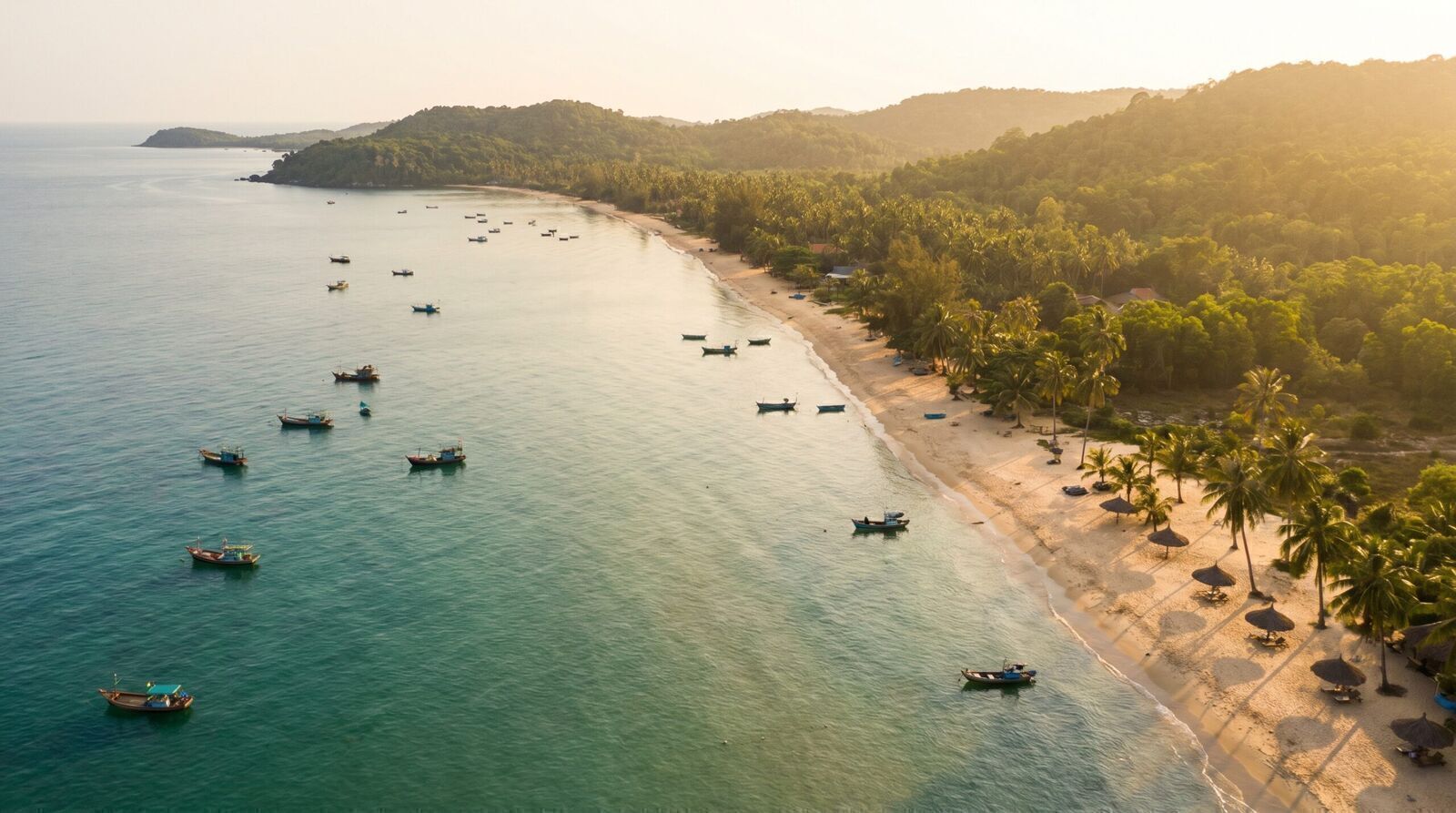
Phu Quoc is Vietnam’s biggest island — a 50km stretch of beaches in the Gulf of Thailand with a 30-day visa exemption for every nationality, mid-range days from $40–60 per person, and two swim-ready coasts that trade places with the seasons. This is our complete guide: when to go, where to stay, what it really costs and what deserves your time — distilled from the 25 detailed guides we have written from the ground. Zooming out to the whole country? Our complete Vietnam travel guide is the wider map.
Want every number on one page? See our Phu Quoc Price Index — 70+ real prices, kept current.
Use this page as your planning hub. Every section links to a deeper guide when you need the full detail.
| Phu Quoc at a glance | The short answer |
|---|---|
| Visa | 30 days free for all nationalities (fly in direct, island only) |
| Classic season | November–March (west coast); May–October for Sao/Khem beaches |
| Daily budget | $25 backpacker / $40–60 mid-range / $80–120 comfort |
| Ideal stay | 3 days for highlights, 5 for comfort, a month if you can |
| Base for first-timers | Long Beach (Ong Lang for quiet) |
| Signature day | Sao Beach morning + Hon Thom cable car + Sunset Town evening |
First: Is Phu Quoc Right for You?
Honest answer first, because this island is not for everyone. Phu Quoc is a beach-resort escape: soft water, seafood, world-class sunsets, low effort. It is not a culture-first destination like Hoi An, and parts of the south are an active construction zone as the island builds toward its resort future. If your dream trip is temples and old streets, spend more of your Vietnam time elsewhere; if it is sand, swimming and switching your brain off — at half the price of Phuket or Bali — Phu Quoc delivers.
We wrote a full, no-spin verdict in Is Phu Quoc Worth Visiting in 2026? and a head-to-head with its mainland rival in Phu Quoc vs Da Nang.
When to Go: The Two-Coast Rule
Everything about timing Phu Quoc comes down to one idea: the island has two best seasons on opposite coasts. November to March, the west coast (Long Beach, Ong Lang) is calm and postcard-perfect. May to October, the monsoon flips the script — the west gets moody while Sao and Khem beaches in the south-east hit their glassy best. Get the coast right and almost any month works.
- Best all-round window: late November to early December — dry-season weather before Christmas pricing (+20–40%).
- Best value: May–June and October — rooms drop 40–60%, east-coast beaches in form.
- Think twice: September (statistically the wettest) and Tet (Lunar New Year) if you dislike crowds.
The full month-by-month breakdown, with a quick-scan table, lives in our best time to visit guide — and if your dates land in the wet months, read the rainy season, honestly before you panic-cancel anything.
Getting In: Visa and Arrival
Phu Quoc has the easiest entry rules in Vietnam: a special 30-day visa exemption that applies to every nationality — the catch is you must arrive from another country with Phu Quoc as your final destination, either on a direct international flight or a same-day connection that does not clear immigration on the mainland. The rules, the transit trap and the e-visa fallback are all in our Phu Quoc visa guide.
Flights and ferries — including the wave of new direct international routes that opened in 2026 — are mapped in how to get to Phu Quoc. From the airport, a Grab to Long Beach runs about 120,000–200,000 VND ($5–8) and takes 15–25 minutes. Details, scams to skip and resort-transfer advice: airport to hotel.
Where to Stay: Pick the Area First
Phu Quoc is 50km long — the area you sleep in decides your trip. The one-line version of our full area comparison:
- Long Beach — the first-timer default: sunset strip, widest hotel range, walkable dinners.
- Ong Lang — quiet coves and boutique bungalows; our personal favorite base.
- Duong Dong town — cheapest rooms, best food density, no beach at the door.
- The north — mega-resort bubble beside VinWonders and the safari; built for families.
- The south — luxury flagships on Khem Beach, minutes from the cable car.
By budget and style, we keep three shortlists updated: great rooms under $35, the family resorts that actually work, and luxury done right — Phu Quoc’s five-stars run 30–50% below equivalent rooms in Phuket or Bali. Browsing prices? Agoda consistently has the deepest Phu Quoc inventory — compare a couple of areas before you commit.
The Beaches: Match the Coast to the Month
More than 20 named beaches ring the island; eight genuinely matter. The heavyweights: Sao Beach (the whitest sand in Vietnam — at its best May–October, go before 10 AM), Khem Beach (its refined, quieter twin — the Sao vs Khem question is really a season question), Ong Lang (the best year-round balance) and Long Beach (20km of sunset-facing convenience). For the wild-north scooter day, add Bai Dai, Starfish Beach and Ganh Dau.
And every clear evening, the west coast stages the island’s most reliable free attraction — we ranked the seven best sunset spots after a lot of pleasant research.
Things That Are Actually Worth Doing
Phu Quoc’s attraction list is short but strong. Our honest tier list:
- The Hon Thom cable car — the one attraction that earns its hype: 8km over a fishing fleet and an archipelago, ticket bundled with the Aquatopia water park (~$33). Full timing strategy in the cable car guide.
- An Thoi island-hopping boat day — swimming off empty islets and a seafood lunch, $25–45. Set snorkel expectations honestly (the reef truth) and it is a wonderful day.
- The Duong Dong night market — the island’s best dinner: grilled scallops, squid skewers, seafood by weight. How to order like you have done it before.
- VinWonders + Vinpearl Safari — legitimate full family day in the north (~$37 adult). Ticket strategy here.
- The local hour — a pepper farm and fish-sauce barrel house (both nearly free) and lunch on the planks at Ham Ninh fishing village.
Booking tip that saves real money: e-tickets for the cable car and parks run 10–20% cheaper than walk-up prices — check dates and prices on Klook the night before, not at the gate.
Eat Like You Mean It
This island invented dishes that exist nowhere else in Vietnam — bún quậy noodle soup you season yourself, herring salad, crab noodles — plus the country’s most famous fish sauce and peppercorns. Street meals run $1.50–3; a seafood feast at the night market about $12. The full hit list, market etiquette and what to skip: the Phu Quoc food guide. Coffee people: the island pours everything from 40-cent street phin to workable laptop cafés — our café shortlist.
Getting Around
No useful public transport — your real options are Grab (short hops $2–3, cross-island $6–14, perfect for a resort-based trip) or a $5–8/day scooter, which unlocks the wild north and the local corners. Rules of the road, license reality and when to hire a driver instead: getting around Phu Quoc. Land connected: an eSIM with data costs a few dollars and takes five minutes before you fly — the Vietnam eSIM guide.
What It Costs
The honest 2026 numbers: backpackers manage $25 a day, a comfortable mid-range day is $40–60 per person, and treat-yourself mode rarely passes $120 outside the five-star bubble. Street meals $1.50–3, local beer $1, massages $10–15/hour, boat days $25–45. Line-by-line breakdown plus the five classic overspends in the budget guide.
Itineraries: Steal Ours
- 3 days — the greatest-hits shape: sunset + night market, the big southern day, a boat day. About $160 per person plus room.
- 5 days — the same hits plus the north loop and, crucially, days with no agenda at all.
- With kids — the 7-day family version built around calm water, the safari and nap-friendly logistics.
Staying Longer: The Slow Option
Here is the quiet superpower: that 30-day exemption makes Phu Quoc one of the easiest places in Asia to simply stay a month — no paperwork, monthly studios from $250–450, fiber internet as standard. If that idea tugs at you, start with a month in Phu Quoc, then the practicalities: finding monthly rentals and working remotely from the island. It is the reason this site is called Slow Vietnam.
FAQ
How many days do I need in Phu Quoc?
Three full days covers the highlights without rushing; five adds breathing room and the north. Beach-holiday people happily fill a week; the visa gives you thirty.
Is Phu Quoc expensive?
No — it runs 10–20% over mainland Vietnam prices but far below Phuket or Bali for equivalent quality. $50 a day per person buys a genuinely comfortable trip.
Which is better: Phu Quoc or Da Nang?
Different tools: Phu Quoc for an island resort escape, Da Nang for a beach city with urban life attached. The full comparison is in Phu Quoc vs Da Nang.
Is the island safe?
Very, by any regional standard — petty theft is uncommon, scams are mostly of the unconfirmed-seafood-price variety, and the biggest real risk is a scooter ridden overconfidently. Agree prices first, wear the helmet, use reef-safe common sense.
When should I book?
Peak season (mid-December–February): resorts 4–8 weeks ahead, activities a few days out. Shoulder and monsoon months: flights ahead, hotels flexible — last-minute deals are common.
Bottom Line
Thirty visa-free days, two coasts that take turns being perfect, seafood at market prices and Asia’s best-value resort rooms: Phu Quoc rewards travelers who match the coast to the month and go early to everything. Start with the season, pick your area, steal an itinerary above — and if the island gets under your skin, the month-long version is easier than you think.
Some links in this guide are affiliate links: if you book through them we may earn a small commission at no extra cost to you. It helps keep our guides honest and free.
Get our free Phu Quoc Trip Kit — the pre-departure checklist, a 5-day plan and our honest booking picks. No spam; at most one email a month.
By subscribing you agree to our privacy policy. Unsubscribe anytime.