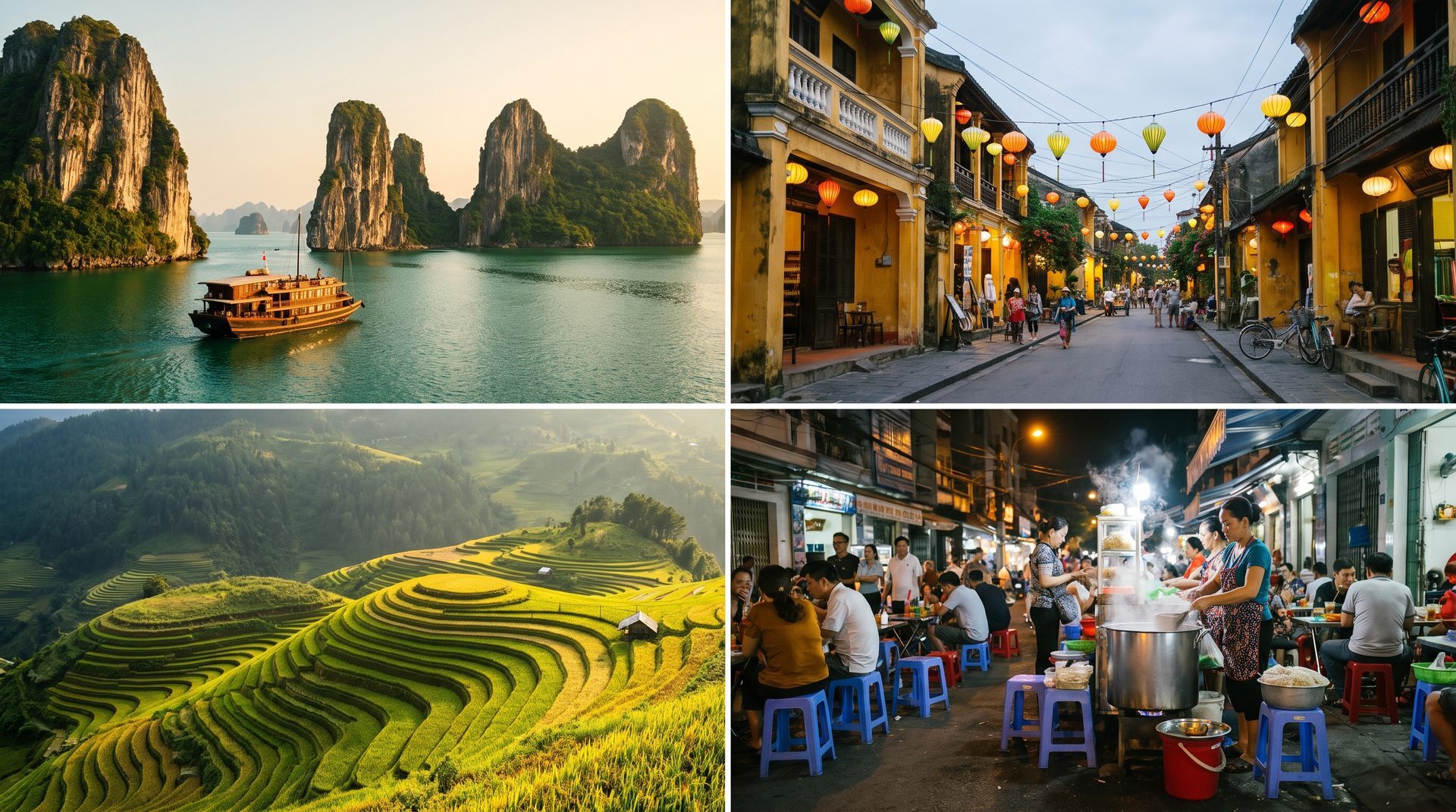
Vietnam is the best-value travel country in Asia right now, and one of the last where the famous version and the real version still live on the same street. You can eat the bowl of phở the guidebooks photograph for $1.50, sleep in a boutique room for $35, and be rowed through a limestone gorge by a woman paddling with her feet — all in the same day, all without a tour bus. This guide is the map to the whole country: where to go, when, for how long, what it costs, and the honest trade-offs nobody puts in the brochure. Everything links onward to our deeper guides — written slowly, from the ground, and updated for 2026.
Vietnam at a Glance
| Question | The short answer |
|---|---|
| Visa | Many nationalities: 30–45 days free. Everyone else: 90-day e-visa, $25 online |
| Money | Vietnamese dong (VND); cash still rules street life — our money guide |
| Daily budget | $30–40 backpacker, $60–90 mid-range, $150+ comfortable |
| Best months | March and November nationally — full breakdown |
| Connectivity | Excellent and cheap — install an eSIM before you land |
| Safety | Very safe for travelers; traffic and phone-snatching are the real risks |
The Three Vietnams
The single most useful thing to understand before booking anything: Vietnam is not one destination with one weather system. It is three countries stacked vertically, each with its own climate, food and temperament — and they rarely have good weather at the same time.
| Region | The character | Anchors | Best months |
|---|---|---|---|
| North | History, mountains, the deepest food | Hanoi, Ninh Binh, Ha Long, Ha Giang | Oct–Apr |
| Center | Heritage coast — beaches plus old towns | Da Nang, Hoi An, Hue | Feb–Aug |
| South | Energy, rivers, islands, dry-season certainty | Saigon, Mekong Delta, Phu Quoc | Nov–Apr |
The north is the Vietnam of rice terraces, karst valleys and Hanoi’s thousand-year-old street rhythm. The center packs the country’s prettiest square mile (Hoi An’s old town), its best beaches-plus-city combination (Da Nang) and its imperial history (Hue) into one short coastline. The south runs on Saigon’s voltage, the Mekong’s slow water, and Phu Quoc’s island dry season. Mountain people head for Sapa or Ha Giang; highland romantics for Dalat; beach collectors add Nha Trang or Mui Ne.
When to Go
There is no single “best time for Vietnam” — there is a best time for each third of it. March and November are the two months when most of the country cooperates at once; the full month-by-month verdicts, including the Tet holiday rules and the typhoon fine print, are in our when-to-visit guide, with a dedicated page for every month of the year. The one date that shapes everything: Tet (Lunar New Year — February 6 in 2027), when the whole country travels at once and half of it closes — our Tet 2027 guide has the dates and closures. Brilliant to witness, terrible to book blind.
How Long? The Itinerary Ladder
| Time | The right shape | The plan |
|---|---|---|
| 1 week | One region, done properly | 7-day itinerary |
| 10 days | Two regions, one flight | 10-day itinerary |
| 2 weeks | The classic top-to-bottom route | 2-week itinerary |
| 1 month+ | Slow bases, not a route | one-month slow route |
The pattern behind the ladder: every extra week buys you a region, and trying to buy two with one week is the classic first-timer error. City-level plans exist for every major stop — Hanoi, Saigon, Da Nang, Hoi An and Ninh Binh — each built on the same principle: the best hours are dawn and dusk, and the itinerary should be too.
Where to Stay
Hotel value is one of Vietnam’s quiet superpowers: $25–55 buys a genuine boutique room almost everywhere, and even luxury runs at half its Thai equivalent. The decision that actually matters is not the hotel but the neighborhood — every city here has zones with completely different personalities. We keep zone-by-zone stay guides for Hanoi, Saigon, Da Nang, Hoi An and Phu Quoc; for everywhere else, browsing Vietnam stays on Agoda with the map open does most of the sorting.
Money, Visas and the Boring Stuff
Three admin items reward ten minutes of preparation. Visa: many passports enter free for 30–45 days; everyone else applies online for the 90-day e-visa ($25, a few days’ processing) — long-stay mechanics, extensions and visa runs live in our visa guide. Money: the dong runs on cash at street level and cards everywhere air-conditioned; the ATM fee table, the counterfeit-note myth and the one scam that matters (DCC — always choose to be charged in VND) are in the money guide. Phone: data is cheap and coverage is excellent — an eSIM installed before departure means Grab works from the airport curb. For what things actually cost on the ground — street food to monthly rents, in actual 2026 numbers — our Vietnam price index is the reference we keep updated.
Getting Around
Distances are longer than the map suggests — Hanoi to Saigon is 1,700 km — so the national toolkit is: domestic flights for the long jumps (frequent, $30–80 booked ahead), limousine vans for the 2–4 hour hops (door to door, $10–20), the Reunification Railway for the scenic coastal legs (the Hue–Da Nang stretch through Hai Van Pass is the prettiest hour of track in Southeast Asia), and Grab for everything inside cities. The full mode-by-mode breakdown — which leg to fly, train, van or bus, with costs — is in our guide to getting around Vietnam. Book an open-jaw flight — into Hanoi, out of Saigon or the reverse — and the country becomes a line instead of a loop. Tours are worth paying for where logistics are genuinely hard: comparing Vietnam tours on Klook covers the cruise-and-trek category well; day-to-day sightseeing here needs no middleman.
The Food, Briefly
Vietnam’s food is regional to a degree that surprises even seasoned eaters: the north keeps it austere and herbal (phở was born in Hanoi and tastes like it), the center eats spicy and imperial (Hue’s royal kitchen, Hoi An’s cao lầu), and the south sweetens everything and doubles the herbs. The rules that never fail: eat where the plastic stools are full, follow the specialists (a shop that makes one dish has made it ten thousand times), and drink the coffee — a culture of its own that costs $1 a cup. City-level eating lists live in our Da Nang food guide and Phu Quoc food guide, priced from real menus. The capital gets its own: the Hanoi food guide, built on the specialist-shop system.
Traveling Slow — the Version We Advocate
Everything on this site argues one position: Vietnam rewards staying longer in fewer places more than any country we know. The cafe culture makes every town livable, monthly rents run $250–600, and the difference between the tourist’s Vietnam and the traveler’s Vietnam is usually just a second week. If that appeals, our slow travel guide is the manifesto, the base comparison picks your city, and the one-month budget shows the surprisingly gentle math.
The Mistakes Every First-Timer Makes
Booking the route before checking the monsoon. The classic two-week plan collapses when it meets the central coast in October or Hanoi in its January drizzle — Vietnam punishes itineraries written from a map instead of a calendar. Five minutes with the month guides prevents the single most common bad trip we hear about.
Treating distances like Europe. “We will just pop from Hoi An to Sapa” is a 1,000-kilometer sentence. The country is long, the trains are slow by design, and every transfer eats half a day — which is why the itinerary ladder above trades places for depth at every rung.
Day-tripping the things that need a night. Ha Long as a day tour is mostly bus; Ninh Binh and Hoi An save their best hours — dawn and dusk — for people who slept there. The overnight is the cheapest upgrade in the country: one hotel night, roughly $25, for the entire difference.
Over-planning the food. The restaurant with the tablecloths is rarely the meal you will remember. Leave gaps, follow the full stools, and let the $2 places win — they will anyway.
FAQ
Is Vietnam cheap to travel?
Yes — among the best value in Asia. $30–40 a day covers a backpacker completely; $60–90 buys boutique hotels, restaurant meals and day tours; $150 a day is genuine luxury. The famous dishes cost $1.50–3 on the street. The only Western-priced items are rooftop cocktails, imported wine and peak-season resorts.
Do I need a visa for Vietnam?
Depends on your passport: many European and Asian nationalities enter visa-free for 30–45 days, while US, Canadian and Australian travelers apply online for the 90-day e-visa ($25, allow about a week). Rules shift — our visa guide has the full 2026 rules by passport, and the long-stay guide keeps the mechanics of extensions and multiple-entry logic.
Is Vietnam safe?
Very, by any regional or global standard — violent crime against visitors is rare. The two risks that are real: traffic (cross slowly and steadily, never step backwards) and motorbike phone-snatching in the big cities (front pocket near roads). Food hygiene at busy stalls is better than its reputation; the crowded place is the safe place.
Should I start in the north or the south?
Match the season, not the convention: October to April favors starting north (Hanoi) and finishing on a southern beach; May to September flips the logic toward the center and south. When both work, we lean toward landing in Hanoi — the culture shock is richer at the start and the beach is a better ending than an opening.
How many days do you need for Vietnam?
Ten days is the honest minimum for two regions; two weeks does the classic north-to-south properly; one week means choosing a single region and doing it well — the shapes are mapped in our itinerary ladder. If you can stretch to a month, Vietnam is one of the world’s best countries to do it in.
Some links in this guide are affiliate links: if you book through them we may earn a small commission at no extra cost to you. It helps keep our guides honest and free.
Get our free Phu Quoc Trip Kit — the pre-departure checklist, a 5-day plan and our honest booking picks. No spam; at most one email a month.
By subscribing you agree to our privacy policy. Unsubscribe anytime.