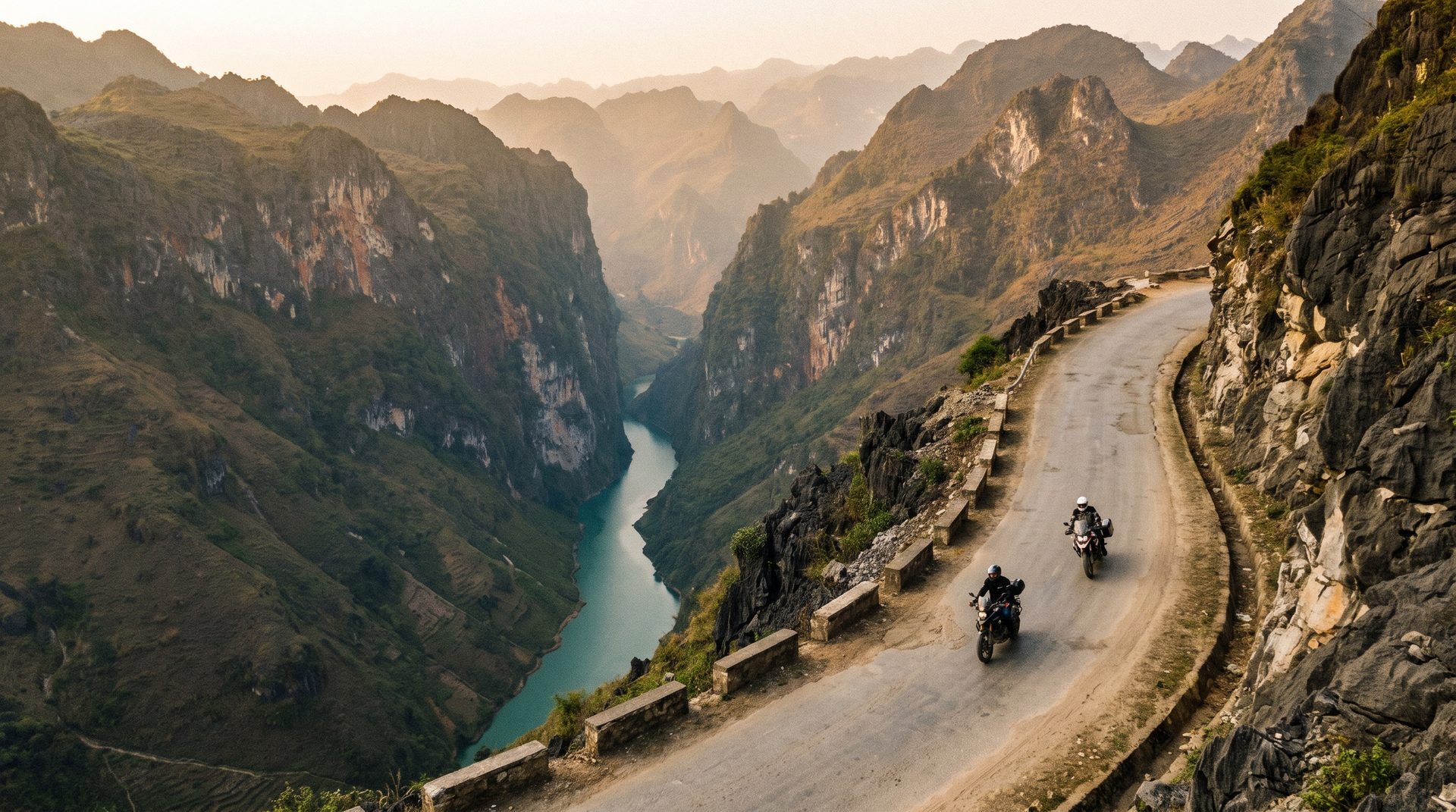
The Ha Giang Loop is the best road in Vietnam and one of the great road trips on Earth: three to four days and roughly 350 kilometers through the Dong Van karst plateau along the Chinese border, on a ribbon of tarmac that spends half its time hanging off the side of a canyon. It is also the part of a Vietnam trip people plan worst — because the questions that actually matter (ride it yourself or take an easy rider? how many days? what about the license?) get answered by whoever is selling something. This is the honest version, from the slow-travel angle: the route, the real costs, the legal fine print and the mistakes that turn the best days of a trip into the hardest.
Short version: take four days if you can spare them, three if you cannot. Ride pillion with an easy rider unless you have genuine mountain-riding experience and a motorcycle-endorsed IDP. Go in October–November or March–May, sleep in the homestays, and do not — under any circumstances — start the loop the same morning your night bus arrives. Details below.
The Route
| Day | Leg | The headline |
|---|---|---|
| 1 | Ha Giang city → Yen Minh | Quan Ba “Heaven’s Gate” viewpoint, first karst valleys |
| 2 | Yen Minh → Dong Van | Lung Cu flag tower at the border, the rock plateau proper |
| 3 | Dong Van → Meo Vac | Ma Pi Leng pass — the road the loop is famous for — and the Nho Que river boat |
| 4 | Meo Vac → Ha Giang (via Du Gia) | Waterfall village, the quiet decompression leg |
The three-day version simply rides day four straight home from Meo Vac — it works, but it turns the last day into pure transit. The fourth day through Du Gia is the one most people skip and most people who took it call their favorite: a village in a rice valley, a swimmable waterfall, and the only leg where the loop stops performing and just lives. Day three’s detour is not optional: get off the bike at Ma Pi Leng, walk a stretch of the skywalk path along the canyon rim, and take the cheap boat ride on the Nho Que river through the Tu San canyon — turquoise water between thousand-meter walls, and the rare famous thing that is better in person than in photos.
Easy Rider vs Riding It Yourself
| Option | Cost (3–4 days) | Who it is for |
|---|---|---|
| Easy rider (you ride pillion) | $150–200 incl. sleeps and most meals | Almost everyone — 90% of the scenery, 10% of the risk |
| Self-ride (rented semi-auto) | $10–15/day bike + fuel + $8–15/night homestays | Experienced riders with a valid license + IDP |
| Car with driver | $250–350 | Families, bad weather, anyone bike-averse |
The honest talk: the loop’s legend was built by backpackers self-riding on rented Honda Waves, and plenty still do. But the legal position is unambiguous — riding here requires a motorcycle license from home plus a 1968-convention International Driving Permit with the motorcycle category, and without them you are uninsured on a mountain road where fog, trucks and gravel corners are routine. Police checks on the loop are a fact of life, and the fine is the cheap part; the uncovered hospital bill is not. None of this is a reason to skip Ha Giang — it is the reason the easy rider exists: a local who has ridden these passes a thousand times drives, you watch the canyon instead of the pothole, and the price includes the homestays and the stories. We recommend it without embarrassment, the same way our Sapa vs Ha Giang comparison does.
Getting There, the Permit, and the One Rule
Ha Giang city is six to seven hours from Hanoi by limousine van or sleeper bus ($12–20). The night bus looks efficient and is the loop’s classic self-sabotage: it arrives between three and five in the morning, and starting a mountain ride sleepless is how the best day of the itinerary becomes an endurance event. The one rule: build in a buffer night in Ha Giang city — take the morning bus, sleep properly, start fresh. Foreigners also need a small border-area permit for the plateau; every hostel, hotel and tour arranges it in minutes for a few dollars, so it is a line item, not a task. Book your first and last nights ahead; comparing Ha Giang stays on Agoda covers the city bookends, and the loop homestays between them are walk-in friendly outside holiday weeks. If you would rather have the whole thing packaged — transfers, driver, sleeps — the Ha Giang tours on Klook run the standard 3–4 day formats from Hanoi.
When to Go
Two windows do the loop justice. October–November is the headline act: the clearest, driest riding weather of the year, and from late October the plateau blooms pink with buckwheat — the second season our October guide is built around. March–May is the green mirror: warming air, planting season in the valleys, fewer riders. September works if you accept some rain in exchange for the golden harvest weeks on the approach roads; June’s freshly flooded terraces have their own logic in the mirror season. December to February is genuinely cold up there — beautiful in its stark way, but pack for single-digit nights and expect fog to eat some views.
What the Homestays Are Actually Like
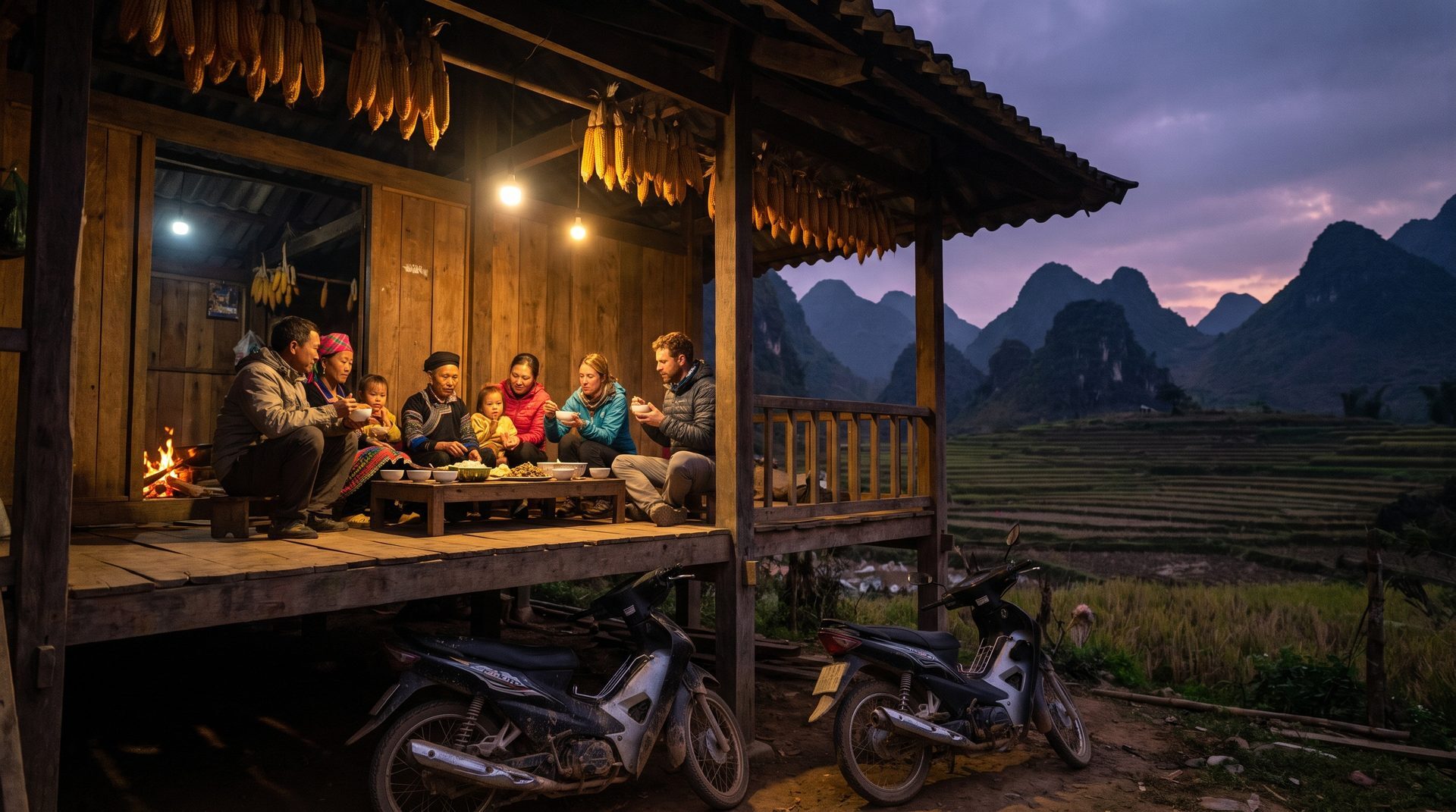
Basic, warm, and the point. A loop homestay is a stilt house or family compound with mattresses on platforms, blankets that mean it, shared bathrooms and a communal dinner where the family’s corn wine makes its rounds — H’mong, Tay and Lo Lo villages host most of them. Sleep runs $8–15 with dinner and breakfast often included, the food is mountain-simple and good, and the evenings are the part of the loop no viewpoint can give you. Manage expectations on plumbing, bring a headlamp, and say yes to the corn wine once.
Three Mistakes That Ruin the Loop
Racing it in two days — the distances look short until you learn that 60 mountain kilometers take three hours with stops, and the loop compressed becomes a saddle marathon past scenery you paid to see. Starting straight off the night bus — covered above, still the most common error on the road. Treating it as a photo checklist — the loop’s famous viewpoints all have parking lots and crowds at midday; the road between them, ridden slowly, is the actual attraction. Leave slack for the unplanned stops — a market, a funeral procession, a valley you want ten more minutes with. That slack is the trip.
Where it fits in a bigger route: the loop is the crescendo of any northern itinerary — pair it with Hanoi and Ninh Binh in a one-week north trip, or slot it into the two-week route in place of a beach leg if mountains outrank sand for you. Do the Sapa question first (the comparison settles it; our Sapa guide has the plan if the trek wins), sort the eSIM before you leave Hanoi — coverage on the plateau is better than you expect, but shops are not — and check the month against the national calendar before locking dates.
FAQ
How many days do you need for the Ha Giang Loop?
Four days is the loop as designed — three riding days plus the Du Gia decompression leg. Three days works and is the most common package. Two days is possible and recommended by nobody who has done it; you spend the scenery budget on transit. Add a buffer night in Ha Giang city before day one.
Do I need a license to ride the Ha Giang Loop?
To self-ride legally: yes — a home motorcycle license plus a 1968-convention IDP with the motorcycle category, and police do check on the loop. Without both, you ride uninsured. The easy-rider option requires nothing but the booking, which is a large part of why we recommend it for most travelers.
Is the Ha Giang Loop dangerous?
The road itself is paved and maintained; the risk is the combination of exposure, weather and rider fatigue. Pillion with an experienced easy rider, the risk profile drops to that of any mountain drive. Self-riding it as your first mountain route, in fog, on no sleep — that is where the horror stories come from.
Ha Giang or Sapa?
Different products: Sapa is a trekking base with infrastructure and soft landings; Ha Giang is a raw road trip with basic sleeps and bigger payoffs. Fit both in a week-plus north trip — trek first, loop second — or let our full comparison break the tie by month and travel style.
When is buckwheat season in Ha Giang?
Late October through November, when the tam giác mạch fields turn the rock plateau pink-white — celebrated with a local festival and coinciding with the loop’s best riding weather. It is the single best window of the year; book the Hanoi buses and first-night stays ahead in those weeks.
Some links in this guide are affiliate links: if you book through them we may earn a small commission at no extra cost to you. It helps keep our guides honest and free.
Get our free Phu Quoc Trip Kit — the pre-departure checklist, a 5-day plan and our honest booking picks. No spam; at most one email a month.
By subscribing you agree to our privacy policy. Unsubscribe anytime.