Hanoi perfected Vietnamese food; Saigon collected it. For three centuries this port city has absorbed cooks from the Mekong Delta, central Vietnam, southern China and, briefly, France — and every wave left dishes behind. The result is the widest eating in the country: sweeter than the north, louder, open later, and gloriously unbothered by tradition for its own sake. Hanoi runs on a clock — one dish, one shop, one hour. Saigon barely owns a watch. The decode here is different: you eat by neighborhood, and the city will feed you properly at 6 AM or 2 AM without judgment.
Short version: cơm tấm or hủ tiếu for breakfast, a bánh mì from a cart whenever, an apartment-café pause mid-morning, bánh xèo or Chợ Lớn noodles in the afternoon, and the great Saigon institution — a sidewalk ốc session — after dark. Follow the full plastic stools, and know that the same cơm tấm grill that woke you up will still be smoking at midnight. Dish-by-dish table with prices below.
How Saigon Eats: Three Things to Know
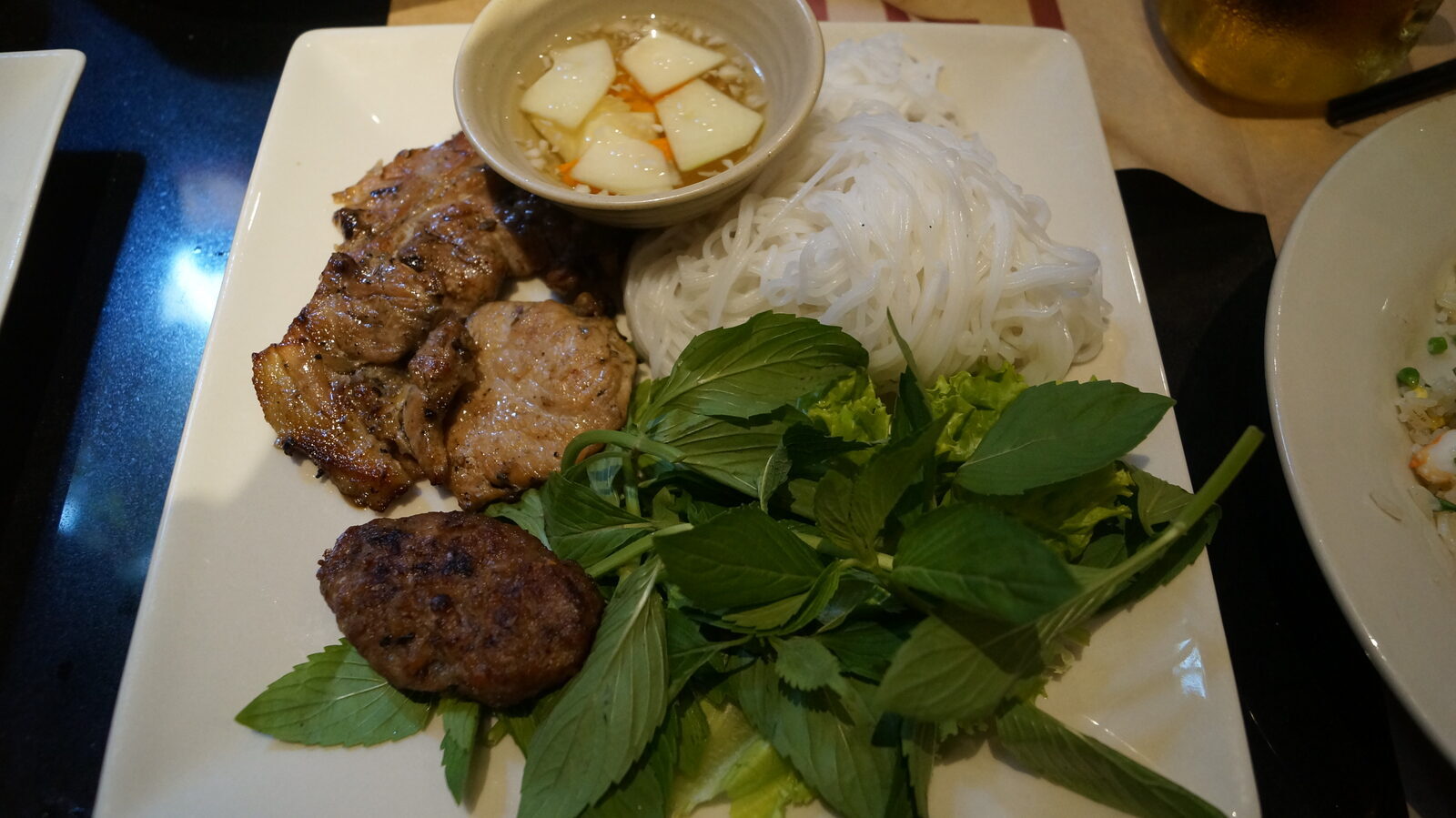
It runs sweet. Southern broths carry a little sugar, the herb plate arrives as a small forest, and coconut sneaks into everything — travelers raised on northern phở notice within one bowl. It has no closing time. Hanoi’s bún chả sells out by mid-afternoon; Saigon’s signature move is the breakfast dish served again at midnight, charcoal relit for the late shift. It eats by district. Bàn Cờ and the District 3 alleys for old-school specialists, District 4 for shellfish nights, Chợ Lớn for the Chinese canon, District 1 towers hiding apartment cafés up crumbling staircases. Pick a zone per meal, not a restaurant per day.
The Non-Negotiables
| Dish | What it is | When | Street price |
|---|---|---|---|
| Cơm tấm | Broken rice, charcoal pork chop, fried egg | Breakfast & late night | 35–60k VND |
| Hủ tiếu | The southern noodle soup — clear, faintly sweet | Morning | 35–55k |
| Bánh mì | The southern build: pâté, cold cuts, pickles | All day | 20–35k |
| Ốc | Sidewalk shellfish plates, grilled or sauced | Evening | 40–90k a plate |
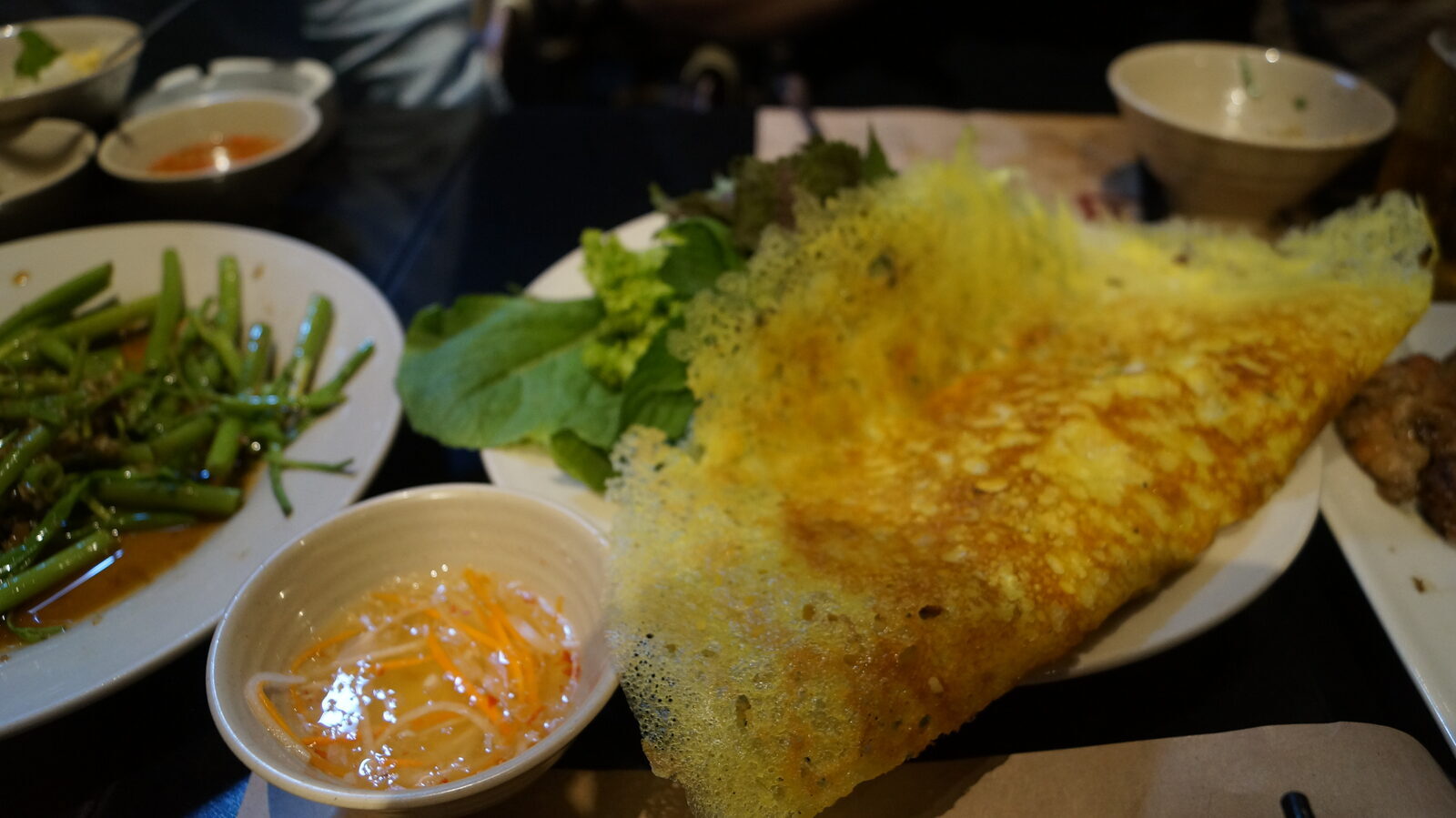
| Bánh xèo | Crackling turmeric crepe, wrapped in greens | Afternoon–dinner | from ~50k |
| Cà phê sữa đá | Iced robusta over condensed milk | Anytime | 15–25k |
| Chè | Sweet dessert soups over ice | Afternoon–night | 15–30k |
The Morning: Charcoal Smoke and Broken Rice
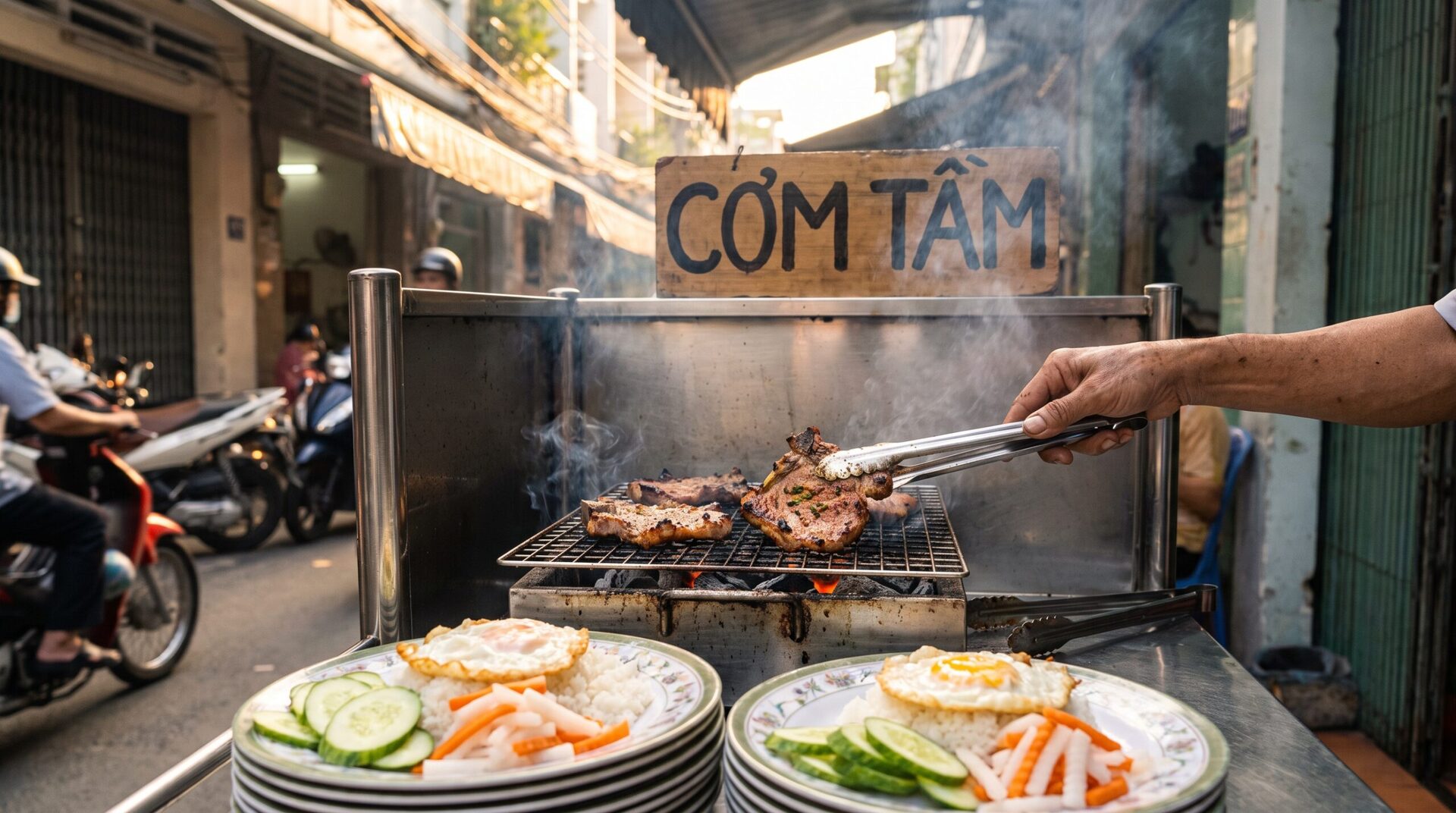
Saigon’s alarm clock is a cơm tấm grill. Before sunrise, corner stalls start laying lemongrass-marinated pork chops over coals, and the smoke drifting down an alley at 6 AM is the city’s official good morning. Broken rice was once the cheap fraction of the harvest sold to dockworkers; now the plate — smoky chop, fried egg, pickles, fish sauce — is the town’s defining meal at 35–60k. The alternative morning is hủ tiếu, the clear, gently sweet noodle soup that carries the city’s Chinese-Cambodian history in one bowl; order it nước (soup) for the classic or khô (dry, sauce-tossed) for the local move. And the bánh mì carts run from dawn: the southern build stacks pâté, cold cuts, pickled daikon and chili into what remains the country’s best $1.50 (our slow guide budgets a whole day around eating like this).
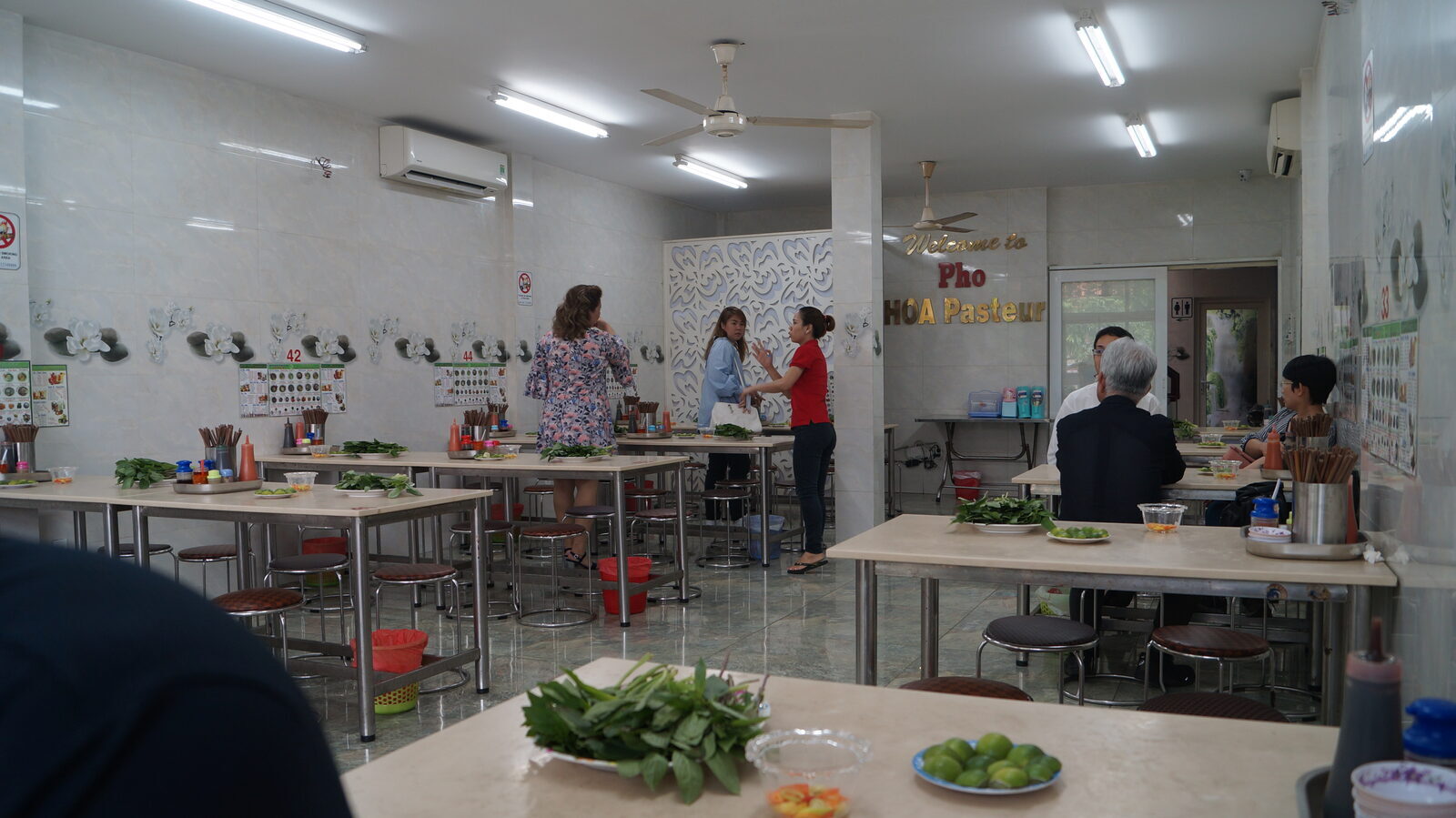
And yes, Saigon does phở — its own way. The southern bowl runs sweeter and arrives with the full hedge of basil, sawtooth herb and bean sprouts that Hanoi would consider vandalism. The classic place to taste the difference is Phở Hòa on Pasteur street, a decades-old institution where every table is pre-loaded with herbs and limes before you even sit down.
The Night: Ốc, the Great Saigon Ritual
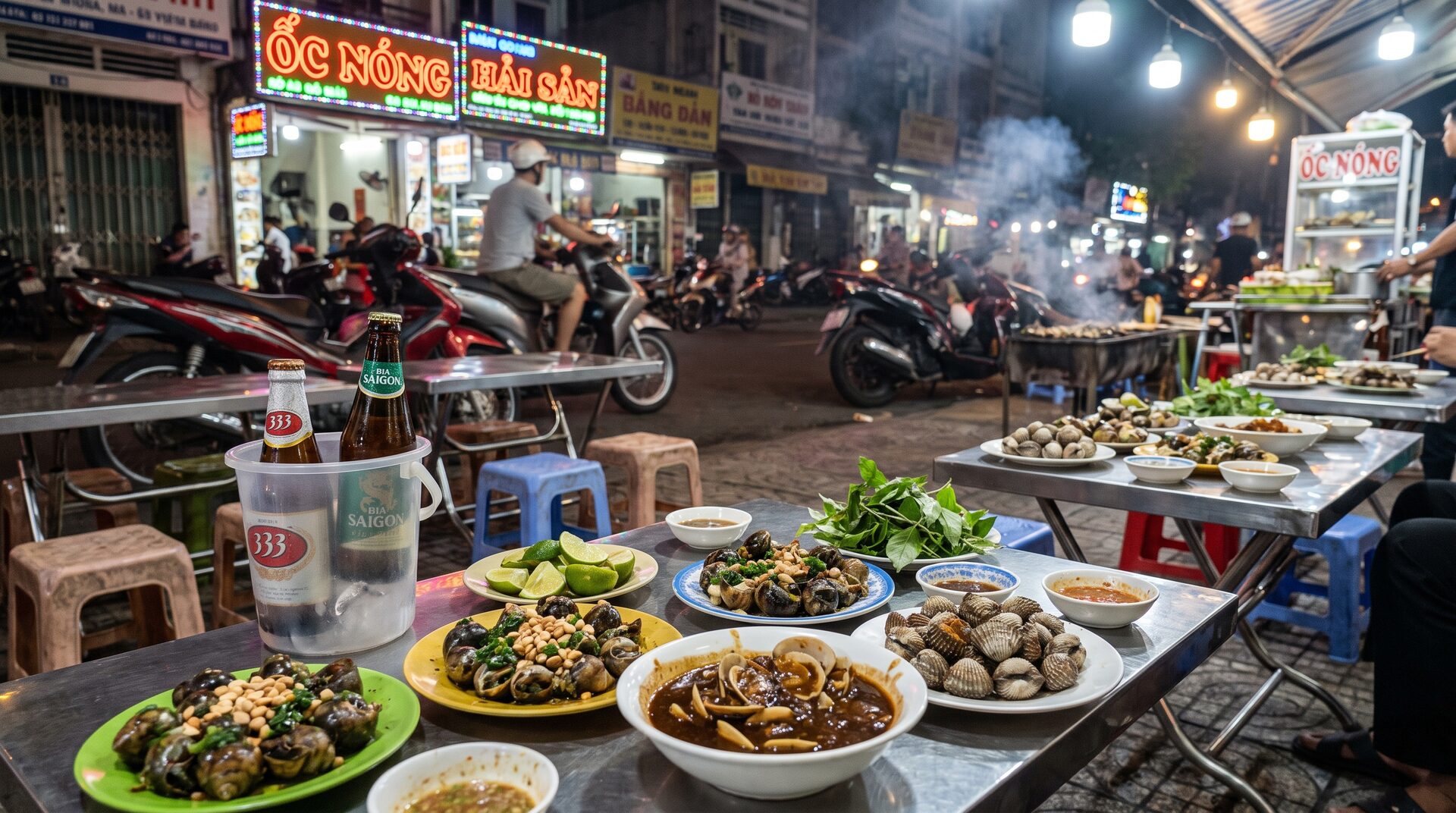
If Hanoi’s evening institution is the bia hơi corner, Saigon’s is the ốc table. From late afternoon, whole streets convert to shellfish service: snails, clams, blood cockles and scallops sold by the plate, each in its assigned preparation — grilled with scallion oil, rolled in salted egg yolk, drowned in tamarind and chili, steamed in lemongrass. You order three or four plates for the table, beer arrives in buckets of ice, and the meal is designed to last hours. The famous strip is Vĩnh Khánh street in District 4, ten minutes from the center and worth the ride for the theater alone — but any neighborhood ốc quán with full stools delivers the same night. Plates run 40–90k depending on the shellfish; point at what the next table has and you will not order wrong. It is loud, messy, faintly chaotic, and the single most Saigon thing you can do after dark.
Chợ Lớn: The Oldest Kitchen in Town
Saigon’s Chinatown — Chợ Lớn, sprawling across District 5 — has been cooking continuously since the eighteenth century, and it is where the city’s noodle history lives. This is the home turf of hủ tiếu and of mì (springy Cantonese egg noodles served with wontons and char siu), of morning dim sum carts, of roast duck hung in glass cases along the market streets. Come hungry in the morning, wander the wet market edges around Bình Tây, and eat wherever the queue is longest. Half a day here pairs naturally with the itinerary’s Chinatown afternoon in our 3 day Saigon plan — and it is the strongest argument that Saigon’s food story is really an immigration story.
Where the Eating Actually Is
Zones beat addresses. Bàn Cờ market and the District 3 alleys hold the old-school specialist density — this is where our stay guide tells connoisseurs to sleep for a reason. District 4’s Vĩnh Khánh owns the shellfish night. Chợ Lớn owns the Chinese canon. District 1 hides its best cafés inside decaying apartment blocks on Nguyễn Huệ and Tôn Thất Đạm — climbing the staircases is the point. If you want the pattern decoded for you on night one, the Saigon street food tours on Klook — many run by motorbike, which is the correct vehicle for this city — are a legitimate shortcut; after one evening you will have the map and never need another.
How it compares: Hanoi eats deeper, Saigon eats wider — the north’s austere masterpiece system is decoded in our Hanoi food guide, the central coast’s seafood economics in the Da Nang food guide, and the island’s fish-sauce-and-seafood register in the Phu Quoc food guide. Nationwide menu-level numbers live in the Vietnam price index.
FAQ
What food is Ho Chi Minh City famous for?
Cơm tấm (broken rice with charcoal-grilled pork), hủ tiếu noodle soup, the southern bánh mì, sidewalk ốc (shellfish) nights, bánh xèo crepes and cà phê sữa đá. Saigon’s real signature is breadth: as Vietnam’s immigrant port city it serves every region’s food, in a sweeter southern register, at every hour.
Is street food safe to eat in Saigon?
At busy stalls, yes — the full-stools rule does your vetting, because high turnover means nothing sits in the heat. Favor cooked-to-order dishes, ease in over your first day, and treat gleaming emptiness as more suspicious than plastic-stool chaos. The genuine street caution in Saigon is phone snatching, not food poisoning — keep the phone off the curb-side hand while you eat.
What is cơm tấm?
Broken rice — grains fractured during milling, once sold cheap to workers — served with a lemongrass pork chop grilled over charcoal, usually a fried egg, shredded pork skin, pickles and sweet fish sauce. It began as a laborer’s breakfast and became the city’s all-hours icon; the late-night version, cơm tấm đêm, is a Saigon institution of its own.
Which city is better for food, Hanoi or Saigon?
Honest answer: Hanoi for depth, Saigon for range. Hanoi’s specialist shops perfect a handful of dishes to generational polish; Saigon serves the whole country plus its Chinese and Khmer inheritance, later into the night and with more sugar. Eat both directions of the argument — they are 90 minutes apart by air.
How much does street food cost in Saigon?
Benchmarks: cơm tấm and hủ tiếu 35–60k VND ($1.40–2.40), bánh mì 20–35k, street coffee 15–25k, chè dessert 15–30k, ốc plates 40–90k each. A $12 day eats spectacularly, ốc night included. If a stall quotes tourist-double, smile and walk one street over.
Some links in this guide are affiliate links: if you book through them we may earn a small commission at no extra cost to you. It helps keep our guides honest and free.
Get our free Phu Quoc Trip Kit — the pre-departure checklist, a 5-day plan and our honest booking picks. No spam; at most one email a month.
By subscribing you agree to our privacy policy. Unsubscribe anytime.