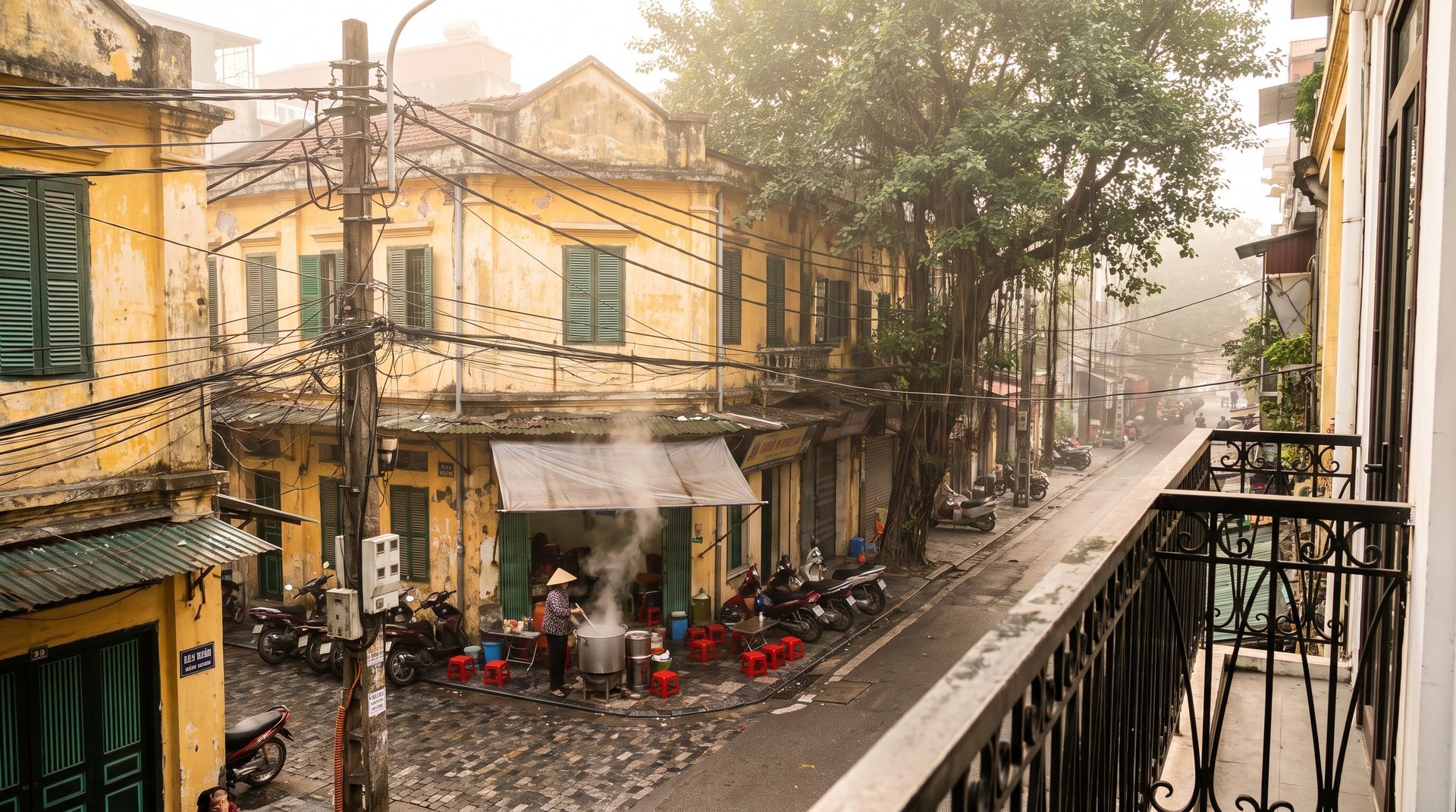
Where you stay in Hanoi decides which city you wake up in. Book the Old Quarter and you live inside the machine — phở steam under the window at six, motorbikes threading the guild streets, the best food in Vietnam three steps from your door, and the noise that comes with all of it. Book the French Quarter and you watch the same city from a wide pavement under plane trees, with an opera house instead of a karaoke bar on the corner. Book West Lake and you are not visiting Hanoi so much as living alongside it. None of these is wrong; they are three different capitals wearing one name, and this guide is the honest sorting of them.
Short version: first visit on two or three nights — take a back room on the Old Quarter edge near Hoan Kiem lake and accept the city’s soundtrack. Light sleepers and comfort travelers — the French Quarter, ten calm minutes south. Week-plus stays and remote workers — Tay Ho, without hesitation. The comparison table, each zone in detail, the winter note most guides skip and the booking tactics are below.
The Four Zones at a Glance
nn

| Zone | Typical price | Best for | The catch |
|---|---|---|---|
| Old Quarter core | $20–70 | First visits, food at the door | Noise around the clock, windowless rooms |
| French Quarter / Hoan Kiem south | $60–180 | Calm nights, grand-hotel comfort | A ten-minute walk to the action |
| Tay Ho (West Lake) | $30–100 | Long stays, cafes, remote work | 15-minute Grab to the sights |
| Truc Bach / Ba Dinh edge | $25–60 | Quiet middle ground, lake evenings | Thin hotel selection, mostly local |
The Old Quarter — Inside the Machine
Staying in the 36 guild streets is the version of Hanoi most people came for, and for a first visit of two or three nights it is still the right call: you walk out of breakfast into the morning market, the lake is five minutes on foot, and the city’s dawn — the hour it is most itself — belongs to you. The trade is real, though. Old Quarter hotels live inside tube houses three meters wide, which means many rooms have no window at all — always check, and pay the $5 upgrade for one. Front rooms hear motorbikes until midnight and the wet market from five; back rooms are the difference between charming and sleepless. And give the Ta Hien beer corner a two-block radius unless you plan to be part of it. The sweet spot is the quarter’s southern and western edges near the lake — close enough to walk everything, buffered from the 24-hour core.
The French Quarter — Hanoi at Arm’s Length
South of Hoan Kiem lake the streets suddenly widen, the pavements grow plane trees, and the architecture turns colonial: this is where Hanoi keeps its grand hotels, from the Metropole down through a tier of handsome four-stars that cost less than a mid-range room in Europe. Nights are genuinely quiet, the Opera House and the museum row are neighbors, and the Old Quarter is a pleasant ten-minute walk rather than a soundtrack. This is the zone for second visits, for anyone whose holiday depends on sleep, and for travelers who want the city in doses rather than intravenously. The only honest catch is that you will make that ten-minute walk several times a day — which, given the walk, is barely a catch.
Tay Ho — The Long-Stay Capital

Around West Lake, fifteen minutes north of the center, Hanoi loosens its collar. Tay Ho is where the city’s expats and remote workers settle, and the infrastructure follows: lakeside cafes that understand a laptop morning, international groceries, yoga studios, apartments and small hotels at $30–100 that would cost double in the center. The lake loop itself — lotus ponds, the Tran Quoc pagoda, sunset joggers — is the best free evening in the city. The trade is distance: every sight is a Grab ride away, which makes Tay Ho the wrong base for a two-night sprint and the obviously right one for anything past five nights. It is the reason Hanoi sits in our long-stay base comparison at all.
Truc Bach and the Ba Dinh Edge — The Quiet Middle
Between the Old Quarter and West Lake sits a small lake district most visitors only cross by taxi: Truc Bach, with its evening lake path, its island of phở cuốn restaurants, and a handful of small hotels at local prices. Base here and you are ten minutes from the Old Quarter one way and the mausoleum quarter the other, in a neighborhood that goes to bed at a reasonable hour because it is mostly Vietnamese. The selection is thin — this is a zone you pick a specific well-reviewed hotel in, not a zone you browse — but for travelers who want central and calm at $25–60, it is the city’s quietest good answer.
The Winter Note Most Guides Skip
From December to February Hanoi is 10–17°C and damp, wrapped in the fine drizzle the north calls mưa phùn — atmospheric to walk in, miserable to sleep cold in. Budget tube hotels often heat poorly or not at all: in those months, confirm the room has a working heater and hot-water pressure before you book, and spend the extra $10 on the better place. The French Quarter’s solid colonial walls and the newer Tay Ho apartments handle winter best. Context for the season sits in our January guide — the short version is that winter Hanoi is worth it, but only warm.
Booking Tactics That Actually Matter
Hanoi is not a scarce market — the city holds thousands of rooms and the baseline value is excellent — but the specific good ones are finite: the well-reviewed $30–60 lake-edge boutiques and the best Tay Ho apartments sell out for weekends, the October–December dry season and Tet well ahead. Book those as soon as dates firm; the rest of the year, a week’s notice is plenty. Comparing Hanoi stays on Agoda shows all four zones on one map, which is the fastest way to see the geography make the decision for you. Then match the nights to our 3 day Hanoi itinerary — or the full week in the slow guide — and the trip plans itself.
Three mistakes we keep watching people make: booking a front-facing Old Quarter balcony because the photo looked romantic (back rooms, always); choosing Tay Ho for a two-night first visit and spending a quarter of it in Grabs; and treating the hotel as just a bed when Hanoi is a city whose best hours — dawn at the lake, egg coffee mid-morning — reward stepping straight out the door. If Hanoi is the northern leg of a longer route, the one-week north itinerary shows how the base fits the region — and our stay guides for Hoi An and Da Nang sort the central-coast half of the decision the same way. The Saigon guide covers the southern leg and completes the set.
FAQ
Is it better to stay in the Old Quarter or the French Quarter?
First visit of two or three nights: the Old Quarter edge near the lake, for the dawn and the food density nothing else matches. Light sleepers, longer visits and comfort budgets: the French Quarter — the same walkable center, minus the soundtrack. The honest tiebreaker is sleep: if noise ruins your days, the choice makes itself.
Is the Old Quarter too noisy to sleep in?
Front rooms on busy streets, often yes — motorbikes late, markets early, karaoke somewhere always. Back or courtyard rooms in the quarter’s southern lake-side edge are fine for most people. The two rules: never book a room without seeing that it has a window, and check recent reviews for the word “noise” before anything else.
How many nights do you need in Hanoi?
Three nights covers the city properly — the Old Quarter day, the grand-city day and a Ninh Binh day trip, as mapped in our itinerary. Two works without the day trip. Past four, move the base to Tay Ho and let the city become a routine instead of a checklist.
Where should families stay in Hanoi?
The French Quarter for short visits — quiet nights, pavements wide enough for small legs, and the lake playground ten minutes away. For longer family stays, Tay Ho’s apartments and lakeside space win. The Old Quarter core is the one zone that punishes families: noise at bedtime and no pavement to push anything on.
Is Hanoi cheap for hotels?
By any Western measure, yes — $25–40 buys a clean boutique double with breakfast, $60–90 a genuinely handsome four-star, and even the Metropole tier costs a fraction of its European equivalents. The only expensive mistakes are Tet week and booking the cheapest windowless room in the Old Quarter to save $5 you will regret.
Some links in this guide are affiliate links: if you book through them we may earn a small commission at no extra cost to you. It helps keep our guides honest and free.
Get our free Phu Quoc Trip Kit — the pre-departure checklist, a 5-day plan and our honest booking picks. No spam; at most one email a month.
By subscribing you agree to our privacy policy. Unsubscribe anytime.