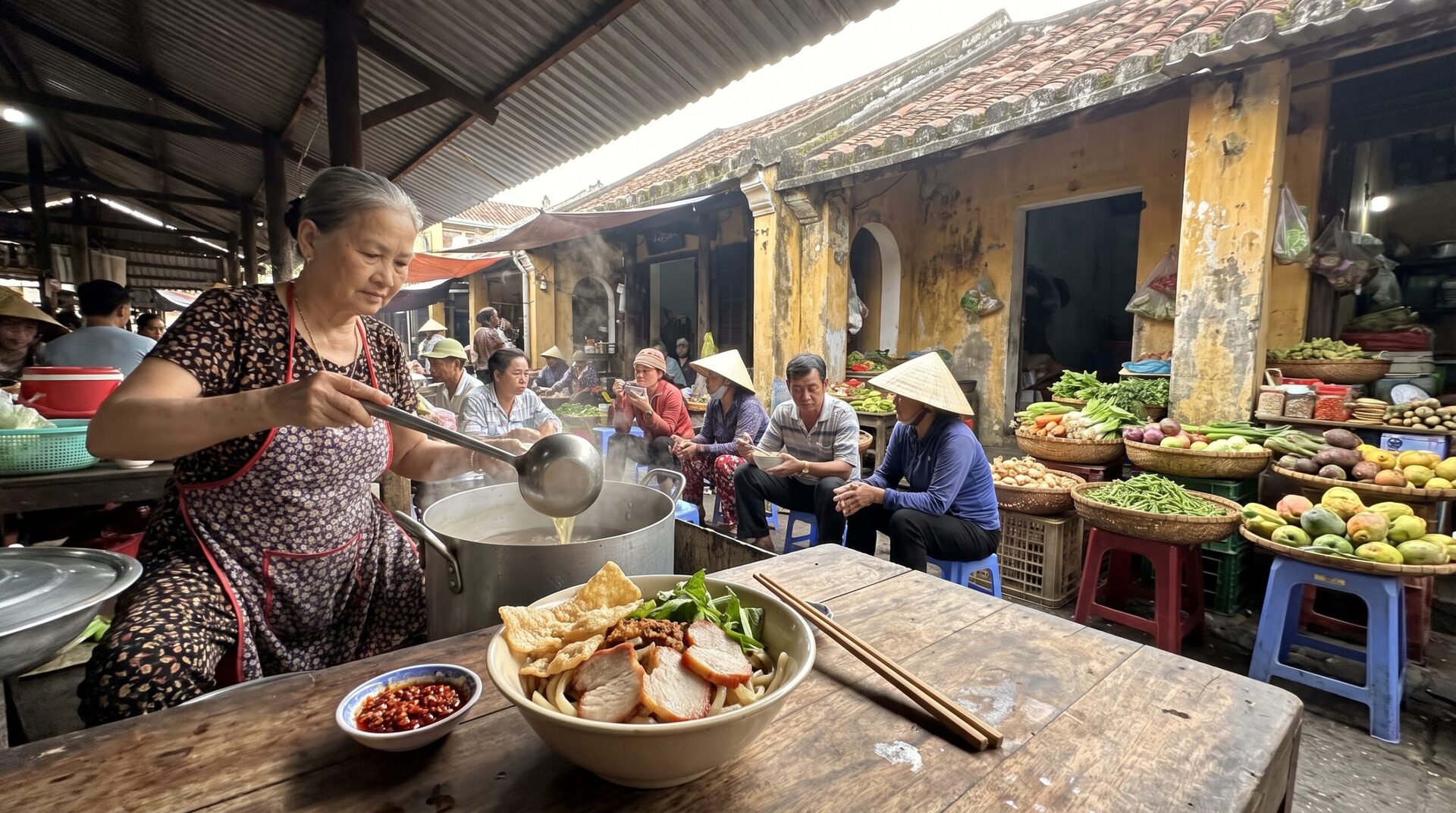
Hoi An is the smallest great food town in Vietnam, and it holds a card no other city can play: dishes that exist nowhere else on earth. Hanoi perfected the specialist shop, Saigon collected the whole country’s kitchen — Hoi An kept a handful of recipes so local that leaving town technically means leaving the cuisine. Cao lầu is tied by legend to the water of one well. The white rose dumplings that every restaurant serves are said to trace back to a single family workshop. Even the bánh mì here has its own rivalry with queues to match. This guide covers the one-town dishes, the prices, and the only navigation rule you need: the closer you sit to a lantern, the more the same bowl costs.
Short version: cao lầu at the central market for breakfast, white rose and fried wontons as the afternoon snack, the bánh mì queue of your choosing, mì Quảng or cơm gà for dinner across the river. Old Town restaurant prices run roughly double the market stalls for the same recipes — split your meals between both. The dish-by-dish table is below.
The Non-Negotiables
| Dish | What it is | Where best | Street price |
|---|---|---|---|
| Cao lầu | Chewy noodles, char siu pork, crispy crackers | Market stalls, mornings | 35–70k VND |
| White rose | Translucent shrimp dumplings, fried shallots | Old Town houses | 60–80k a plate |
| Bánh mì | The famous rivalry — stacked central-style | The queues (or any cart) | 25–40k |
| Mì Quảng | Turmeric noodles, scant broth, peanuts | Local streets off the center | 30–55k |
| Cơm gà | Hoi An chicken rice, turmeric-gold | Old Town side streets | 35–60k |
| Hoành thánh | Fried wontons under salsa-like topping | Old Town restaurants | 50–90k |
Cao Lầu: The Dish That Cannot Leave Town
Every food town has a signature; Hoi An has a hostage. Cao lầu is a dry bowl — thick, chewy, almost soba-like noodles under slices of five-spice char siu, a handful of greens, and crackers made of the same noodle dough fried crisp. The broth is barely a ladleful, more dressing than soup. The legend, told at every table, is that true cao lầu requires lye from tree ash and water drawn from the ancient Ba Le well — which is why, locals will tell you with complete confidence, it cannot be made properly anywhere else. Whatever the chemistry, the texture is real: nothing else in Vietnam chews like it. Eat it in the morning at the central market, where a bowl runs 35–50k and the fishmongers eat beside you — the same bowl inside a lantern-lit Old Town house is 60–70k and tastes of the rent.
White Rose: One Workshop, Whole Town
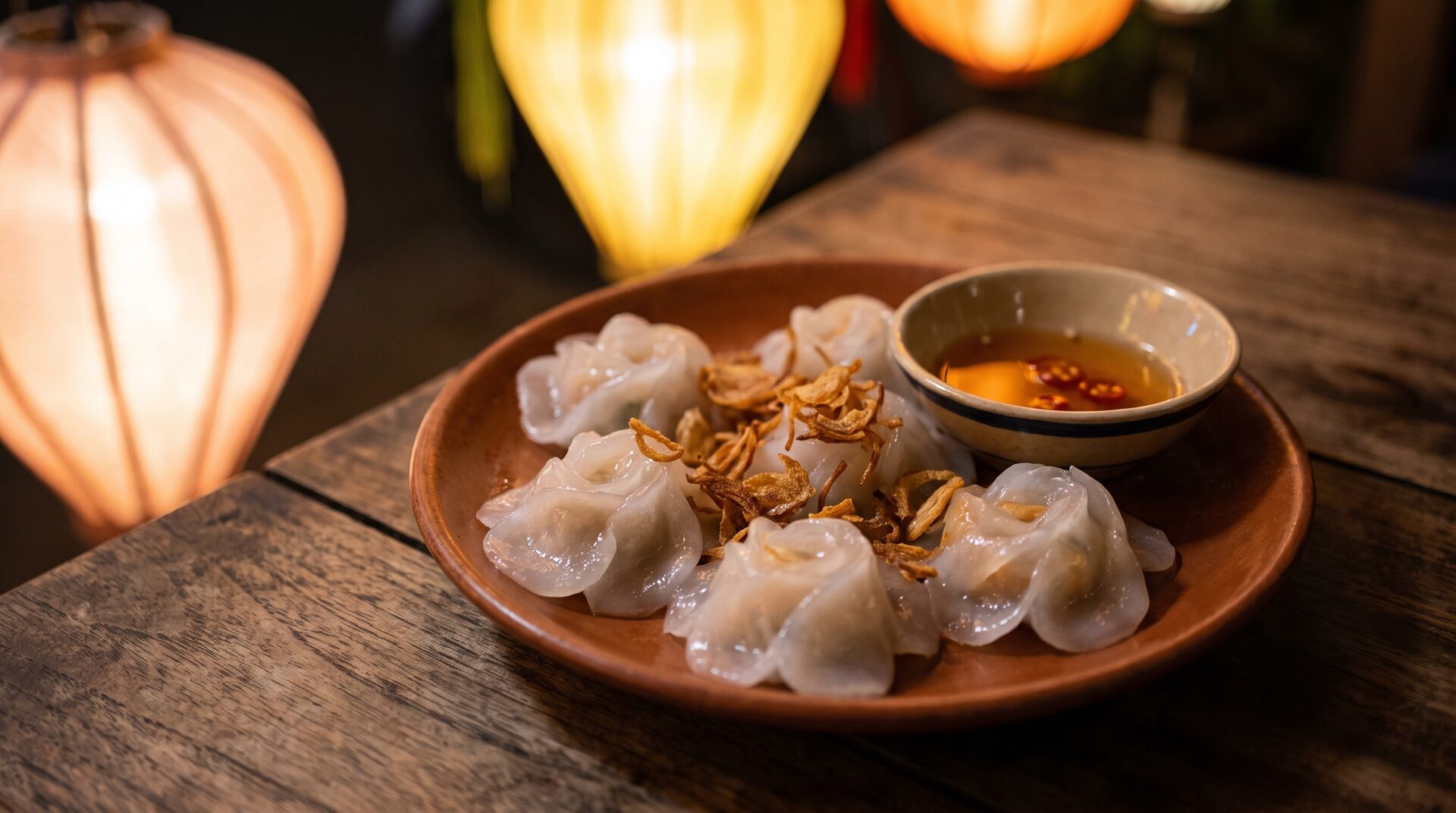
Bánh bao bánh vạc — white rose dumplings — are steamed rice-paper petals pinched around shrimp, scattered with fried shallots and dipped in a light citrusy fish sauce. The town’s open secret is that most restaurants do not make their own: a single family workshop has supplied Hoi An’s white roses for generations, which is why the plate tastes remarkably consistent whether you pay 60k in a side alley or 90k on the waterfront. Order it once as an afternoon snack with the town’s other Chinese-heritage plate, hoành thánh — crackly fried wontons under a warm tomato-shrimp topping that eats like Vietnamese nachos.
The Bánh Mì Rivalry
Hoi An’s bánh mì fame is a two-queue town: Bánh Mì Phượng (the one Anthony Bourdain blessed, with the pilgrimage line to prove it) and Madam Khánh, “The Bánh Mì Queen,” the counter-argument two streets over. Both stack the central style generously — pâté, grilled pork, herbs, a proper chili kick — for 25–40k. Our honest take after eating both: the difference between them is smaller than the difference between queuing twenty minutes and not queuing at all. If the lines are absurd, any busy cart in town is running the same playbook at ninety percent.
Dinner: Mì Quảng, Cơm Gà and the River Rule
Two more central classics close the day. Mì Quảng — wide turmeric noodles with shrimp and pork in a deliberately scant broth, buried under peanuts and rice crackers — is the region’s everyday lunch, best found a few streets away from the heritage core where the plastic stools return. Cơm gà Hội An is the town’s chicken rice: turmeric-gold rice cooked in stock, shredded poached chicken, pickled papaya, a bowl of broth on the side — modest-looking and quietly one of the best plates in central Vietnam. The navigation rule for dinner is the river: cross to the An Hoi side or walk past the market edge, and prices drop by a third while the kitchens stay just as good. The lantern-view tables are for one drink, not the whole meal.
Markets, Classes and the Old Town Markup
The central market food court is the best-value room in town — a dozen stalls, every local dish, nothing over ~60k, open from breakfast. It is also where Hoi An’s famous cooking classes begin their shopping tours: this is the town where taking one actually makes sense, since half the dishes cannot be studied anywhere else — the Hoi An cooking classes on Klook run half a day with a market tour included. Time your eating around the crowds like our 2 day itinerary does — market meals at day-tripper noon, Old Town tables at breakfast and after eight — and the whole town costs half as much.
How it compares: Hoi An eats narrow and irreplaceable — for the north’s specialist depth see our Hanoi food guide, for the south’s wide-open kitchen the Saigon food guide, and for the beach city half an hour north, the Da Nang food guide with its receipt-level prices. Nationwide numbers live in the Vietnam price index.
FAQ
What food is Hoi An famous for?
Cao lầu (the chewy-noodle dish tied to a local well), white rose shrimp dumplings, fried hoành thánh wontons, mì Quảng turmeric noodles, Hoi An chicken rice and a celebrated bánh mì rivalry. Uniquely, several of these are one-town dishes you will not find done properly anywhere else in Vietnam.
What is cao lau?
A dry noodle bowl: thick chewy rice noodles treated with ash lye, sliced five-spice pork, greens, crispy noodle crackers and a few spoonfuls of intense broth. Legend says authentic cao lầu needs water from Hoi An’s ancient Ba Le well — which is why the town guards it as a hometown exclusive. Market stalls serve it from 35k.
Is Hoi An expensive to eat in?
Only where the lanterns are. Old Town heritage-house restaurants charge roughly double the market and side-street rate for the same recipes — 60–90k versus 30–50k a dish. Split your meals: market and across-the-river dinners for value, one lantern-lit table for the atmosphere.
Where should I eat — Old Town restaurants or the market?
Both, on a schedule. The central market food court wins mornings and lunch (best value, most local); Old Town kitchens win after eight when the day-trippers leave. For dinner value, cross the river to the An Hoi side, where prices drop and the view of the lanterns is arguably better than the view from under them.
Is street food in Hoi An safe?
Yes, by the usual Vietnam rules: eat where turnover is fast, favor cooked-to-order dishes, and treat the busy market stalls as the safe choice rather than the risky one. Hoi An adds one caution of its own — the riverfront tourist restaurants with photo menus are a value hazard, not a health one.
Some links in this guide are affiliate links: if you book through them we may earn a small commission at no extra cost to you. It helps keep our guides honest and free.
Get our free Phu Quoc Trip Kit — the pre-departure checklist, a 5-day plan and our honest booking picks. No spam; at most one email a month.
By subscribing you agree to our privacy policy. Unsubscribe anytime.