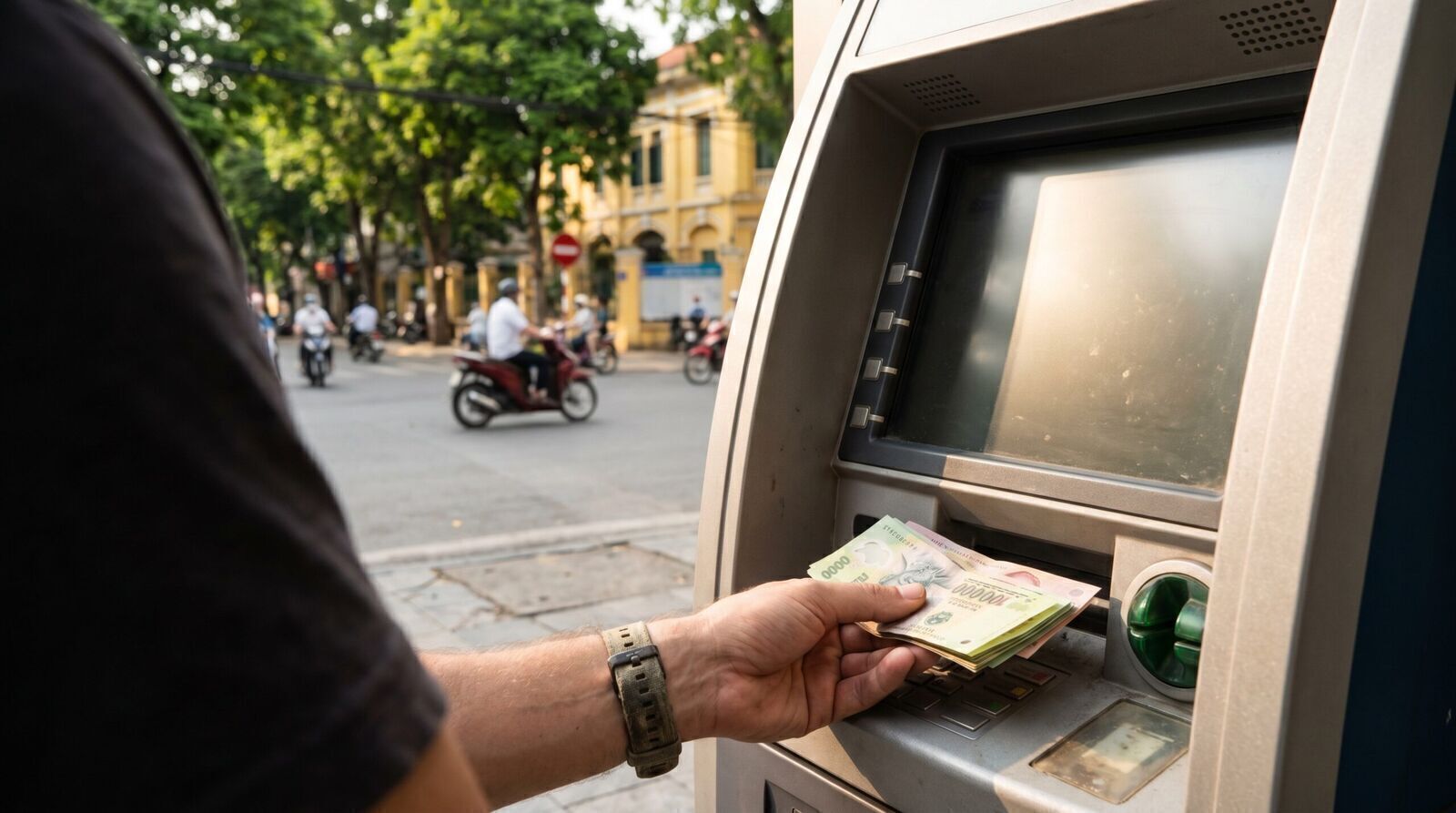
Short answer: Vietnam still runs on cash for the small stuff and cards for the big stuff. Carry 500,000–1,000,000 VND ($20–40) a day in small notes, pay hotels and bigger restaurants by card, withdraw from bank-owned ATMs in big amounts — and always, always decline the ATM’s “convert to your currency” offer, which quietly costs you 3–5%. Here is the whole money system, explained once.
Planning the numbers? Every real price is in our Phu Quoc Price Index.
The Dong, Without the Confusion
Vietnam’s currency has a lot of zeros — 25,500 dong to one US dollar — and the notes are the classic first-week trap: the 20,000 and 500,000 notes are both blue, and the 10,000 and 200,000 are both reddish. Every traveler has a story about paying 25 times too much for a coconut. Two habits fix it:
- Think in “thousands dropped”: mentally knock off three zeros and halve — 100k VND ≈ $4, 500k ≈ $20, 1M ≈ $40.
- Sort your wallet: big notes (200k+) in one slot, small notes in another. Hand over small-slot money at street stalls.
ATMs: The Real Fee Math
| What | The reality |
|---|---|
| Local ATM fee | 50,000–100,000 VND ($2–4) per withdrawal at bank-owned machines |
| Withdrawal limits | Often 2–3M VND per transaction at small banks; 5–10M at bigger ones (VCB, BIDV, TPBank, MB) |
| The smart move | Withdraw the maximum, rarely — one 5M withdrawal beats five 1M ones by ~$10 in fees |
| Dynamic currency conversion | Always press “decline / continue without conversion” — letting the ATM convert costs 3–5% hidden margin |
| Standalone “tourist” ATMs | Skip them — higher fees, worse rates, occasional skimmer risk. Use machines attached to actual bank branches |
Cards: Where They Work (and Don’t)
- Work fine: hotels, resorts, supermarkets, chain cafés, mid-range restaurants in tourist areas, Grab (in-app).
- Cash only: street food, markets, small local restaurants, scooter rentals, beach shacks, most taxis, entrance fees at smaller sights.
- Watch for: a 2–3% card surcharge at some hotels and tour shops — ask before tapping. Visa and Mastercard are universal where cards work; Amex is rare.
- A travel card with no foreign-transaction fee (Wise, Revolut and similar multi-currency cards are the usual picks) saves the 2–3% your home bank quietly charges — over a two-week trip that is real money.
Exchanging Cash: Rankings
- Best rates: gold/jewelry shops in city centers (a Vietnam quirk — perfectly normal practice). Count carefully, know the rate before you go in.
- Banks: slightly worse rate, but official receipts and zero drama. Bring your passport.
- Hotel desks: convenient, mediocre rates — fine for small amounts.
- Airport counters: worst rates in the country. Change only what you need for the first day ($50 worth), do the rest in town — or skip exchanging entirely and just use an ATM at arrivals (even with the fee, it usually beats airport counters).
The Daily System That Works
What we actually do, refined over many trips: land with nothing exchanged, withdraw 3–5M VND from a bank ATM at the airport, sort notes into big/small slots, pay everything under 200k in cash and everything over by card where accepted. Top up cash every 3–4 days. Keep a 500k emergency note somewhere separate. That is the entire system — and it pairs with the Grab-first transport rule so you almost never argue about money in Vietnam.
Can You Use QR Payments Like the Locals Do?
Mostly no, and it is worth understanding why. Vietnamese daily life now runs heavily on bank-app QR codes — but those codes settle between Vietnamese bank accounts, which visitors do not have. As a tourist you will still live on the cash-plus-card system above, with a couple of partial workarounds emerging.
You will see the little QR placards taped to every coffee cart and noodle stall, and locals ahead of you in line paying with a two-second phone scan. Do not let it tempt you into assuming your home banking app will do the same — it will not. As of our last visit, the practical exceptions were narrow: some international travel-money apps have begun adding Vietnam QR compatibility, and a handful of tourist-area merchants accept international wallets. Treat any of it as a bonus if it works, never as a plan.
The upside of this system for travelers is indirect but real: because every tiny vendor can accept instant bank transfers from locals, fewer places bother inflating prices to cover card-terminal fees. Cash remains the universal fallback, and nobody blinks at small notes — especially at the street stalls where the best food in Vietnam is sold.
Small Money Habits That Make Every Day Smoother
- Keep your notes in decent shape. Torn or heavily taped bills get politely refused surprisingly often. If you receive a damaged note in change, hand it back on the spot and ask for another — vendors expect this and swap it without fuss.
- Break big notes deliberately. Convenience stores and supermarkets are the reliable places to turn a 500k into usable small bills; buy a water and the problem is solved. Street stalls genuinely may not hold change for large notes early in the day.
- Expect tiny cash-only fees. Motorbike and bicycle parking at markets, beaches, and temples typically costs a few thousand dong, paid to an attendant. Keep a pocket of the smallest notes just for this.
- There are no coins. Everything is paper, which is why the wallet-sorting habit matters more here than almost anywhere else we travel.
When Money Goes Wrong: The Fix List
| Situation | What to do |
|---|---|
| ATM keeps your card | This is the strongest argument for branch-attached machines during banking hours — walk inside with your passport and staff can usually retrieve it the same day. |
| Card suddenly declined | Usually a fraud block, not a Vietnam problem. Set a travel notice in your banking app before flying and carry a second card from a different bank. |
| Overpaid due to note confusion | Go back calmly and show the note; honest mistakes are usually corrected. The color-twin notes fool locals occasionally too. |
| Leftover dong at departure | Spend down in your final days and re-exchange the rest in town before you leave — airport counters give you the worst rate in the country in both directions. |
| Running low mid-trip in a rural area | Top up before leaving towns; small islands and mountain districts have sparse, low-limit machines. Withdraw ahead, not en route. |
Long-stayers develop their own rhythm around all this — roughly one large withdrawal a week and a card for rent-sized payments. If you are settling in for a month or more, our one-month Vietnam cost breakdown shows how the cash-versus-card split shifts when daily life replaces sightseeing.
FAQ
Should I bring US dollars to exchange?
Crisp large USD notes exchange well at gold shops, so it is a fine backup — but for most travelers, ATM withdrawals with a low-fee card are simpler and just as cheap.
Is Vietnam safe for card payments?
At legitimate businesses, yes. The practical risks are the surcharge surprise and DCC (getting charged in your home currency at a bad rate) — decline conversion at terminals too, not just ATMs.
How much cash for a two-week trip?
Budget travelers burn $25–35/day mostly in cash; mid-range travelers $20–30/day in cash with the rest on cards. Full daily breakdowns in the budget guide.
Can I pay in dollars directly?
Some hotels and tour operators quote USD and accept it, usually at a self-serving rate. Paying in dong is almost always slightly cheaper.
Bottom Line
Cash in small notes for daily life, a no-fee card for the big lines, maximum-size withdrawals from bank ATMs, and two words at every machine: decline conversion. Master that and money in Vietnam becomes a background detail — exactly where it belongs on a good trip.
Get our free Phu Quoc Trip Kit — the pre-departure checklist, a 5-day plan and our honest booking picks. No spam; at most one email a month.
By subscribing you agree to our privacy policy. Unsubscribe anytime.